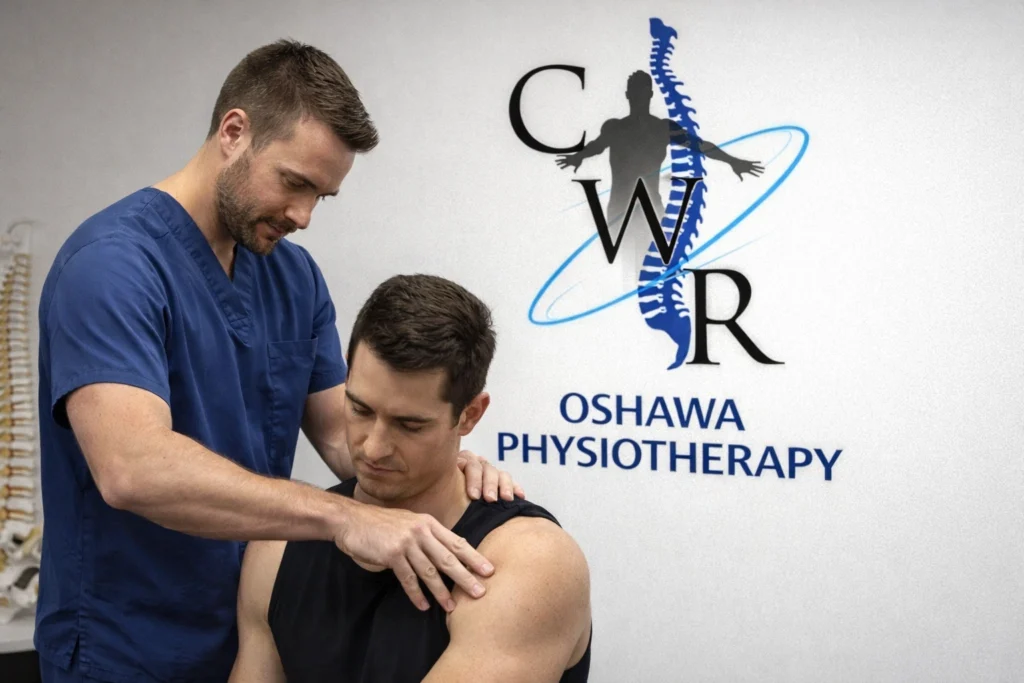

Most episodes of back pain resolve within a few weeks, yet the default response for millions of people is still to rest, take anti-inflammatories, and wait it out. Physiotherapy for back pain takes a fundamentally different approach: it identifies the root cause and corrects it through a progressive plan, rather than simply managing discomfort until it fades. Rest and symptom-focused care often fail to address the underlying mechanical contributors, which is why many people find themselves dealing with the same pain again months down the line.
Active rehabilitation outperforms passive treatment for both short-term relief and functional recovery. Systematic reviews consistently show that exercise-based physiotherapy produces better pain and disability outcomes than passive modalities alone, particularly over the medium and long term. The difference is not subtle.
This article gives you the practical side of that evidence. You will get the key exercises, a structured 4-week home program, the red flags that bypass home exercise entirely, and realistic timelines for what recovery actually looks like. Clinics like Oshawa Physiotherapy (Recovery & Wellness Center) build their back pain programs around exactly this framework: thorough assessment, hands-on treatment, and a progressive exercise plan built around your specific presentation.
Physiotherapy for Back Pain: How It Works
Many people assume physiotherapy for back pain means lying on a table while someone applies heat or ultrasound. That is a common misconception, and it matters because passive modalities alone produce weak long-term outcomes. The evidence-based approach rests on four clinical pillars, and each one earns its place.
Assessment comes first. Your physiotherapist determines whether your pain is mechanical (muscle or joint-driven), disc-related, nerve-related, or postural before prescribing anything. Without accurate classification, there is a real risk of prescribing exercises that aggravate rather than improve the condition. Getting this step right changes everything about the treatment plan.
Manual therapy, meaning hands-on joint mobilization and soft tissue techniques, reduces pain and restores movement in the early stages. Research consistently shows that combining manual therapy with exercise produces better short-term outcomes for subacute and chronic pain than either approach alone. It may reduce guarding faster, which allows you to load the spine more effectively during exercise.
Exercise rehabilitation follows. The goal is progressive loading to rebuild the deep stabilizing muscles of the spine, particularly the multifidus and transversus abdominis, which are reliably inhibited by pain. Patient education ties it all together: posture, load management, activity pacing, and self-management strategies that reduce the likelihood of recurrence. Exercise therapy carries the strongest overall evidence base among conservative back pain treatments, supported by multiple systematic reviews and network meta-analyses. Passive modalities can support recovery, but they do not replace the active work.
What to Expect at Your First Physio Appointment
If you have never been assessed by a physiotherapist for back pain, the first appointment is more thorough than most people expect. In a Canadian clinical setting, it typically runs 45 to 60 minutes and covers a lot of ground before any treatment begins.
The subjective history comes first: when the pain started, what makes it worse, what makes it better, whether it radiates into the leg, and whether you have had previous episodes. This conversation tells the physiotherapist more than most imaging studies do for straightforward mechanical pain. You do not need a referral from a physician to book an appointment in Ontario, though some insurance plans may require one for reimbursement.
The physical assessment follows. Your physio evaluates posture, range of motion in all planes, neurological status (reflexes, sensation, strength), and movement patterns under load. They are looking for contributing factors: hip mobility restrictions, weak glutes, poor thoracic mobility, altered movement patterns that put excessive stress on the lumbar spine.
Based on those findings, the physiotherapist classifies the pain type and builds a treatment plan with short-term and longer-term goals. Most first appointments end with some hands-on treatment and two or three initial exercises to start the rehabilitation process immediately. At Oshawa Physiotherapy (Recovery & Wellness Center), that first session also flags whether chiropractic or massage therapy would add value to the plan, so the decision happens in one place rather than through a chain of separate referrals, a practical advantage of having multiple disciplines coordinated under one roof. For ongoing tips and articles on injury recovery, see the Oshawa Physiotherapy Blog.
Physiotherapy for Back Pain: The Most Effective Exercises
The right exercises depend heavily on whether you are in the acute or chronic phase. Applying strengthening work during acute muscle guarding is counterproductive. Loading a chronically deconditioned spine with only gentle stretches produces no meaningful change. The distinction matters.
For clear demonstrations and extra stretching options you can perform safely, review the best stretches and exercises for lower back pain recommended by clinicians.
Exercises for acute back pain: releasing the spasm first
In the acute phase, generally the first two to six weeks when pain and muscle guarding are still elevated, the goal is to calm the nervous system’s protective response before adding any load. These three exercises accomplish that without compressing an irritated spine.
- Knee-to-chest stretch: Lie on your back, pull one knee toward your chest, and hold for 20 to 30 seconds. Repeat three times per side. This reduces tension and guarding in the lumbar extensors and hip flexors during the painful phase.
- Posterior pelvic tilt: Lie on your back with knees bent. Flatten your lower back into the floor and hold for five seconds, then release. Ten repetitions, two sets. This activates the deep abdominals without applying compressive load to the spine.
- Sidelying spinal rotation: Lie on your side with knees bent. Slowly rotate your top knee toward the floor, moving through a comfortable range. Ten to fifteen reps per side. This decompresses the facet joints with minimal loading.
Exercises for chronic low back pain: building the foundation
Once guarding has settled, typically when resting pain is below three out of ten and movement no longer triggers sharp protective responses, the work shifts to dynamic strengthening and mobility to address the movement deficits that sustain chronic pain. These four exercises form the core of most low back pain rehabilitation programs.
- Cat-cow: On hands and knees, alternate between arching and rounding the spine slowly. Ten repetitions. Restores segmental spinal mobility and encourages fluid movement through the intervertebral discs.
- Bird-dog: From the same position, extend the opposite arm and leg simultaneously while keeping the spine neutral. Ten reps per side. This is a well-supported, commonly recommended exercise for training spinal stability under low load. Evidence for targeted spinal stabilization exercises and their effect on movement performance is discussed in the literature, including relevantJOSPT evidence on spinal stabilization.
- Glute bridge: Lie on your back with feet flat. Lift your hips until your body forms a straight line from knees to shoulders, hold five seconds, and lower. Ten reps. Targets posterior chain activation, which is commonly impaired in people with chronic back pain.
- Neural glide (for sciatica or radiating leg pain): Supine, pull your knee to your chest, then slowly straighten the leg with your foot flexed. Hold five seconds, return, repeat ten times. This reduces tension along the sciatic nerve pathway without the risk of overstretching.
Your 4-Week Home Program for Low Back Pain Recovery
Structure and progression are what separate a recovery program from a random collection of exercises. This four-week framework follows research on optimal loading progression and exercise compliance in physio for back pain.
Weeks 1 and 2: pain relief and movement restoration
Keep the volume low and the exercises straightforward. Three sessions per week, 15 to 20 minutes each. Select two or three exercises from the acute phase list (knee-to-chest, pelvic tilt, sidelying rotation) and perform two sets of eight to ten reps, holding each position for five seconds.
Your benchmark for this phase: pain should not increase beyond a three out of ten during exercise, this is a widely used clinical heuristic, though your physiotherapist may adjust the threshold based on your specific presentation. Movement without guarding is the goal, not fatigue. Studies on exercise adherence consistently show that prescribing more than three exercises per session reduces completion rates, so keep it simple enough that you actually do it.
Weeks 3 and 4: building strength and load tolerance
Progress to the chronic-phase exercises: cat-cow, bird-dog, glute bridge, and neural glides. In week three, perform two sets of twelve reps. In week four, increase to three sets of twelve. Add a light daily walk of ten to fifteen minutes. Walking supports circulation, loading tolerance, and overall spine function, benefits well-documented in research on low back pain management.
Track one measurable marker each week: how far you can bend forward, how long you can sit without pain, or how long morning stiffness lasts before it clears. Tracking keeps you honest about whether the program is working. At the four-week mark, reassess with your physiotherapist. If progress is consistent, the program advances. If it has stalled, the plan changes.
Back Pain Red Flags That Require Professional Assessment, Not Home Exercises
Self-management works well for the vast majority of mechanical back pain presentations, but not for all of them. Knowing when to step back from home exercises and seek care protects you from harm.
Stop home exercises and seek emergency care immediately if you experience any of the following:
- Loss of bowel or bladder control: this is a possible cauda equina syndrome presentation and requires emergency surgical evaluation.
- Progressive leg weakness, numbness, or tingling that worsens over hours or days: this suggests active nerve or spinal cord compression that requires imaging and urgent assessment.
- Severe pain unrelieved by any position, particularly at night: possible fracture, spinal infection, or tumor.
- Fever or chills alongside back pain, or unexplained weight loss: these systemic signs require urgent workup to rule out spinal infection or metastatic disease.
- Pain following significant trauma such as a fall, accident, or collision: raises fracture risk regardless of your age or fitness level.
For a concise clinical overview of common warning signs and when to seek urgent care, see the Oshawa Physiotherapy Clinic overview of back pain. Even without red flags, back pain that has not improved after two weeks of consistent self-management warrants a professional assessment. A physiotherapist can accurately classify your pain type, rule out serious pathology, and adjust the program in real time based on how your body responds. No article can replicate that.
Having multiple disciplines available under one roof makes a practical difference in that process. At Oshawa Physiotherapy (Recovery & Wellness Center), physiotherapists, chiropractors, and massage therapists work from a shared plan. If your back pain has a facet component that responds to chiropractic care, or a soft tissue layer that benefits from massage, those adjustments can be incorporated without the delays or communication gaps that come with separate referrals. For more targeted resources on managing persistent symptoms, see our Pain Management, Oshawa Physiotherapy section.
How Long Does Physiotherapy Take to Relieve Back Pain?
The timeline depends primarily on how long you have had the pain and how early you start treatment. Acute low back pain, pain present for fewer than six weeks, typically shows meaningful improvement over two to four weeks of consistent physiotherapy for back pain combined with a home exercise program. Most patients in this category notice real change within the first two to three weeks.
Subacute and chronic pain, meaning pain that has persisted beyond six weeks, follows a longer arc. Evidence supports an eight-week guided program as a reasonable minimum baseline for chronic presentations, with significant functional gains expected by week six. The total number of sessions is individualized. If progress stalls, a competent physiotherapist adjusts the goals and approach rather than repeating the same program indefinitely.
Several factors consistently influence how quickly people recover. Early intervention carries significant weight: research comparing early versus delayed care shows that beginning spine rehabilitation within the first two weeks of onset is associated with meaningfully better outcomes and lower recurrence rates. Quality sleep, low background stress, and high compliance with home exercises all accelerate recovery. Delayed treatment, fear-avoidance behavior (avoiding movement because you expect it to cause harm), and physically demanding work without load management strategies all slow it down. For a deeper look at the evidence behind exercise-based approaches and outcomes, review this systematic review.
Getting Back to Full Function: The Bottom Line
Physiotherapy for back pain works through a combination of accurate assessment, hands-on manual therapy, and progressive exercise. No single element is sufficient on its own. The 4-week program outlined here is a safe and evidence-informed starting point for mechanical back pain, but it produces better results when guided by a professional who can see how your body actually moves and adjust accordingly.
If you recognize any of the red flag symptoms described above, skip the home program and seek care the same day. For everyone else, the four-week framework gives you a structured, low-barrier entry point into low back pain rehabilitation with clear weekly benchmarks and a defined reassessment point.
If back pain is disrupting your daily life, work, sleep, or activity, booking with a qualified physiotherapist is the most direct path forward. For those in Oshawa and the broader Durham Region, Oshawa Physiotherapy (Recovery & Wellness Center) offers physiotherapy, chiropractic care, and massage therapy within a coordinated, multi-disciplinary plan. Seven-day availability, direct billing to major insurers, and free on-site parking mean the practical barriers that often delay treatment are addressed before you even arrive. To learn why many people choose to see a clinician, review our Top 5 Reasons to Visit a Physiotherapist. The evidence for active rehabilitation is solid, and getting started is simpler than most people expect.